
Business Website AI Search Optimization Checklist
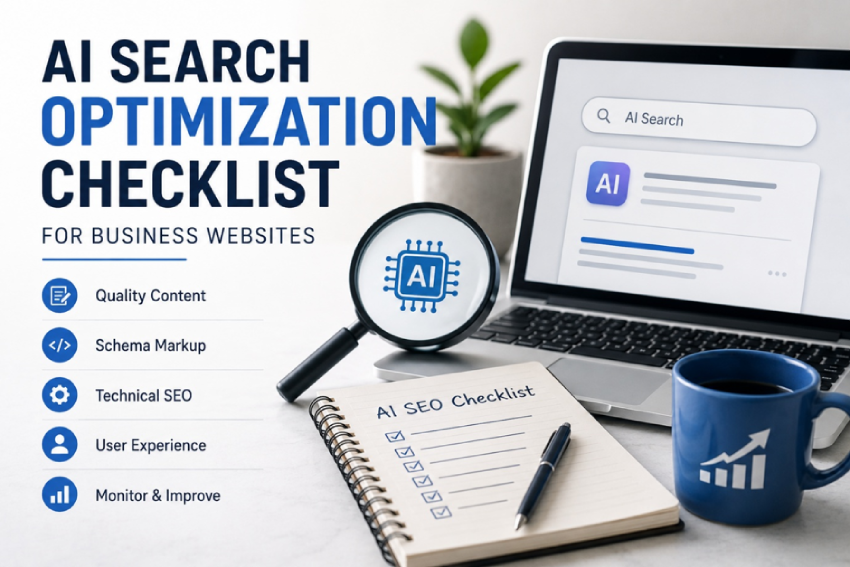
Search is changing faster than ever before. While traditional SEO still has value, companies need to look beyond Google’s ten blue links. Answer engines powered by artificial intelligence such as ChatGPT, Google AI Overviews, Gemini and Perplexity are revolutionizing the way people search for businesses, products and services.

These services don’t just send you back web pages; they give you the answer right away, getting the info from reliable, authoritative, well-organized sites. Failing to get your website ready for this change could mean missing out on important opportunities to connect with prospective clients.
This AI SEO checklist will help you create an AI-ready website, boost your visibility on AI-powered search platforms, and improve your answer engine optimization (AEO) strategy. If you own a local business or an eCommerce store, these best practices will help you future-proof your site for search.
The Significance of AI Search Optimization
Old school SEO is about getting web pages to rank in search results. AI search optimization is about helping AI systems to understand, trust and cite your content when generating responses.
Today’s AI systems consider much more than keywords. They also consider site authority, structured information, user experience, topical expertise, and content quality before choosing sources to use as references.
Companies that optimize early will get ahead of the competition as AI-powered search grows. Search engines are increasingly rewarding websites that provide valuable, trustworthy and well-organized information.
AI Search Optimization Checklist
1. Produce Useful, Unique Content
AI systems reward websites that actually help people with their problems.
Don’t just make content to rank for keywords. Provide helpful and accurate answers to real questions your customers are asking.
The content you post should:
- Solve one particular problem.
- Test your knowledge.
- Use real examples wherever possible.
- Make it easy to read.
- Keep it up to date.
Good educational content also helps establish your website as an authority in the industry.
2. Use Proper Heading Structure on Your Website
A well-structured page is easier to understand for both users and AI systems.
Use:
- One H1 heading
- Logical H2 and H3 headings
- Short paragraphs
- Bullet points
- Numbered lists
- Descriptive section titles
Structure content in a clear hierarchy so that answer engines can more easily find the information they need.
3. Add Schema Markup
Schema markup is one of the most powerful signals you can send to search engines and AI systems.
Structured data helps identify:
- Business information
- Services
- Products
- FAQs
- Reviews
- Articles
- Contact information
- Directions
Google recommends using JSON-LD for structured data because it provides the right context without changing the page content. The correct schema also increases the chances of earning rich search results.
4. Improve Your Technical SEO
You still need a technically strong website for AI search.
Review your website for:
- Fast loading speeds
- Mobile-friendly design
- Secure HTTPS connection
- Crawlable pages
- Clean URL structure
- XML sitemap
- Internal links
- Optimized images
These improvements help search engines index your website more efficiently while improving user experience. SEO-friendly website development, responsive design, and website performance are also part of WinnipegTech’s web solutions.
5. Build Subject Authority
Don’t publish standalone blog posts. Create multiple pieces of content around related topics.
If you provide SEO services, your website should cover topics such as:
- Local SEO
- Technical SEO
- Website speed
- Structured data
- AI search optimization
- SEO content strategy
- eCommerce SEO
This helps AI recognize your website as a reliable source of information within your niche.
6. Optimize for Voice Search
Users now ask complete questions instead of typing short keywords.
Instead of only focusing on:
“SEO Winnipeg”
Also create content that answers questions like:
- How can I optimize my website for ChatGPT?
- What is Answer Engine Optimization?
- How do AI search engines rank websites?
- What does it take to make a website AI-ready?
Conversational questions have a better chance of being featured in AI-generated answers.
7. Improve Internal Linking
Internal links help AI understand how your content relates to other pages on your website.
Where relevant, link blog articles to important pages such as:
- SEO Services
- Website Design
- WordPress Development
- eCommerce Development
- About Us
- Contact Us
A strong internal linking structure improves topical relevance and makes your website easier to navigate. WinnipegTech already uses educational blogs to support its SEO and website development services.
8. Keep Your Website Updated
AI systems prefer fresh and relevant information.
Regularly update your:
- Service pages
- Homepage
- Blog articles
- FAQs
- Company information
Publishing new, high-quality content shows that your business is active and knowledgeable within your industry.
9. Prioritize Website Experience
Even the best content won’t perform well if your website is difficult to use.
Your AI-ready website should include:
- Fast loading speeds
- Mobile-friendly design
- Easy navigation
- Clear calls to action
- Accessible design
- Secure browsing
WinnipegTech builds responsive, easy-to-navigate, SEO-friendly websites that improve both user experience and search performance.
10. Monitor and Improve Performance
AI search optimization is an ongoing process.
Regularly monitor your website using tools such as:
- Google Search Console
- Google Analytics
- Google PageSpeed Insights
- Google Rich Results Test
Track important metrics including:
- Organic traffic
- User engagement
- Crawl errors
- Core Web Vitals
- Structured data errors
Continuous improvements help your website remain competitive as AI search continues to evolve.
Common AI SEO Mistakes to Avoid
Many businesses are still optimizing only for traditional search engines.
Avoid these common mistakes:
- Publishing duplicate or low-quality content
- Ignoring structured data
- Using outdated information
- Poor internal linking
- Poor website performance
- Keyword stuffing
- Creating content without considering user intent
These issues negatively affect both traditional rankings and AI visibility.
WinnipegTech Is Here to Help
Optimizing for AI-powered search is about much more than adding keywords.
WinnipegTech builds websites that help businesses increase their online visibility. We create websites with responsive design, WordPress development, SEO best practices, technical optimization, and ongoing website support.
As search technology continues to evolve, our team helps businesses stay ahead by building SEO-friendly websites, improving technical performance, and publishing valuable content that performs well in both traditional search engines and AI-powered search.
Conclusion
AI search is transforming how customers discover businesses online. Websites that are technically well-structured, authoritative, and genuinely helpful are more likely to appear in AI-generated responses.
This AI SEO checklist is an excellent first step toward building an AI-ready website that performs well in both traditional search engines and emerging answer engines.If you want to future-proof your website for ChatGPT, improve your answer engine optimization strategy, and prepare for the future of search, WinnipegTech can help you build a website designed for long-term online success.
FAQs
What does AI Search Optimization mean?
AI Search Optimization is the process of optimizing your website so AI-powered platforms like Google AI Overviews, ChatGPT, Gemini, and Perplexity can understand, trust, and reference your content when answering users’ questions.
How can I make my website ChatGPT-friendly?
To optimize your website for ChatGPT:
- Create unique, high-quality content.
- Add schema markup.
- Improve technical SEO.
- Build topical authority.
- Structure your content with clear headings.
- Ensure your website is fast and user-friendly.
What is the difference between SEO and Answer Engine Optimization?
Traditional SEO focuses on improving rankings in search engine results pages. Answer Engine Optimization (AEO) focuses on making your content a trusted source that AI-powered search platforms use to provide direct answers.
Does schema markup help with AI discoverability?
Yes. Schema markup provides structured information about your business, services, products, FAQs, and other content, making it easier for search engines and AI systems to understand and reference your website.
Why do you need an AI-ready website?
An AI-ready website is well-structured, technically optimized, secure, mobile-friendly, and contains valuable content. These qualities improve visibility in both traditional search engines and AI-powered answer engines.
Can WinnipegTech help improve my website for AI search?
Yes. WinnipegTech provides website development, WordPress solutions, SEO, technical optimization, and ongoing website support to help businesses prepare for the future of AI-powered search.